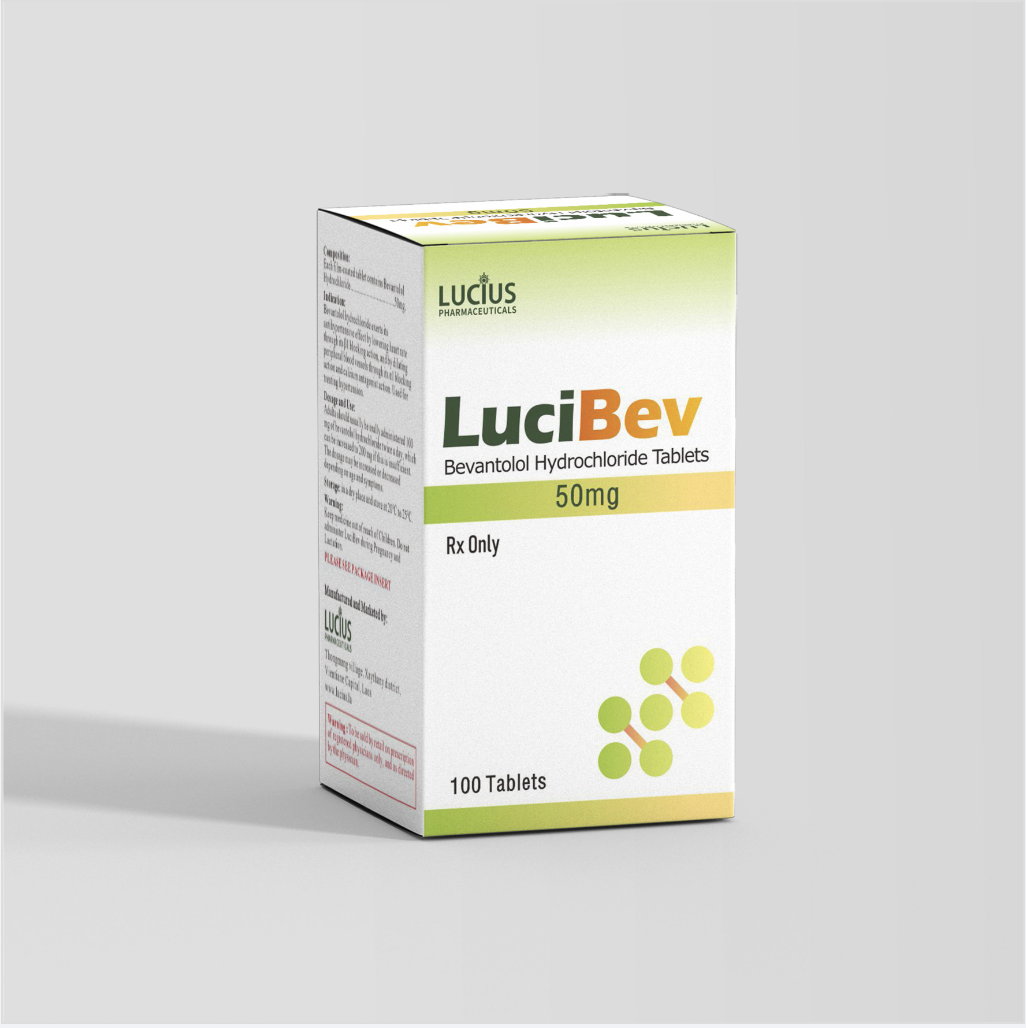


HIGHLIGHTS OF PRESCRIBING INFORMATION
These highlights do not include all the information needed to use LuciBev safely and effectively. See full prescribing information for LuciBev.
INDICATIONS AND USAGE
Hypertension
DOSAGE AND ADMINISTRATION
For adults, bevantolol hydrochloride is usually orally administered at 100 mg per day in two divided doses. If this is not effective, the dose can be increased to 200 mg per day.
The dose may be increased or decreased depending on age and symptoms.
DOSAGE FORMS AND STRENGTHS
Tablets: 50 mg×100 tablets
CONTRAINDICATIONS
Patients with diabetic ketoacidosis or metabolic acidosis [There is a risk of promoting the onset of decreased cardiac contractility, peripheral arterial dilation, and decreased blood pressure due to acidosis.]
Patients with cardiogenic shock [The cardiac function inhibitory effect of this drug may worsen symptoms.]
Patients with congestive heart failure [The cardiac function inhibitory effect of this drug may worsen symptoms.]
Patients with right heart failure due to pulmonary hypertension [The cardiac function inhibitory effect of this drug may worsen symptoms.]
Patients with severe bradycardia (severe sinus bradycardia), atrioventricular block (grade II or III), or sinoatrial block [The cardiac function inhibitory effect of this drug may worsen symptoms.]
Pregnant women or women who may be pregnant [Fetal weight loss has been reported in animal experiments (rats)]
Patients with untreated pheochromocytoma or paraganglioma.
WARNINGS AND PRECAUTIONS
In patients with pheochromocytoma or paraganglioma, this drug should be administered after initial treatment with an alpha-blocker, and should always be administered in combination with an alpha-blocker.
If administration is prolonged, cardiac function tests (pulse, blood pressure, electrocardiogram, X-ray, etc.) should be performed periodically. If symptoms of bradycardia or hypotension are observed, the dosage should be reduced or administration should be discontinued. If necessary, atropine sulfate hydrate should be used. Attention should be paid to liver function, renal function, and blood picture.
There have been reported cases of symptoms worsening or myocardial infarction occurring when administration of a similar compound (propranolol hydrochloride) was suddenly discontinued in patients with angina pectoris. If drug suspension is required, gradually reduce the dosage and observe closely. Also, warn patients not to discontinue administration without a doctor's instructions. Similar precautions should be taken especially in elderly patients.
It is recommended not to administer this drug for 48 hours before surgery.
Dizziness and lightheadedness may occur, so patients (especially in the early stages of administration) should be advised not to drive a car or operate dangerous machinery.
ADVERSE REACTIONS
The following side effects may occur, so observe closely, and if abnormalities are found, discontinue administration or take appropriate measures.
1 Serious side effects
1.1 Heart failure (less than 0.1%), atrioventricular block (less than 1%), sinus dysfunction (incidence unknown).
Heart failure, atrioventricular block, sinus dysfunction (marked sinus bradycardia, sinoatrial block, etc.) may occur.
1.2 Asthma attacks, dyspnea (incidence unknown for both)
Asthma attacks may be induced or aggravated, so if such symptoms are observed, discontinue administration of this drug and take appropriate measures.
USE IN SPECIFIC POPULATIONS
1 Patients with complications or medical history
1.1 Patients at risk of congestive heart failure
Since this drug may induce symptoms, observe closely and administer with caution, such as by using digitalis in combination.
1.2 Patients at risk of bronchial asthma or bronchospasm
Since this drug has also been confirmed to have a β2 blocking effect, it may induce symptoms.
1.3 Patients with idiopathic hypoglycemia, poorly controlled diabetes, or patients who have been fasting for a long period of time
Since this drug is prone to hypoglycemia and tends to mask symptoms of hypoglycemia such as tachycardia, be careful of blood glucose levels.
1.4 Patients with pheochromocytoma or paraganglioma
Since administration of this drug alone may cause a sudden rise in blood pressure. [See 2.7, 7]
2 Patients with renal dysfunction
2.1 Patients with severe renal dysfunction
Since the blood concentration of this drug may increase, it is recommended to start administration at a low dose.
3 Patients with hepatic dysfunction
3.1 Patients with severe hepatic dysfunction
Due to decreased drug metabolism, the effects may be amplified.
4 Pregnant women
Do not administer to pregnant women or women who may be pregnant. In animal experiments (rats), it has been reported that high doses caused a decrease in fetal weight. [See 2.6]
5 Nursing women
Consider continuing or discontinuing breastfeeding, taking into account the therapeutic benefits and the benefits of breastfeeding. Animal studies (rats) have shown that the drug is transferred to breast milk.
6 Children, etc.
No clinical trials have been conducted on children, etc.
7 Elderly people
It is advisable to administer the drug carefully while closely monitoring the progress, such as starting with a low dose (depending on symptoms, for example 50 mg/day), paying attention to the following:
- Generally, physiological functions such as renal function are often impaired. Also, excessive lowering of blood pressure is not recommended.
- If medication is suspended, gradually reduce the dose.
Storage
Store at 20℃ to 25℃ (68℉ to 77℉), excursions permitted between 15℃ and 30℃ (59℉ and 86℉) [see USP Controlled Room Temperature]. Protect from moisture.