

HIGHLIGHTS OF PRESCRIBING INFORMATION
These highlights do not include all the information needed to use LuciRevu safely and effectively. See full prescribing information for LuciRevu.
INDICATIONS AND USAGE
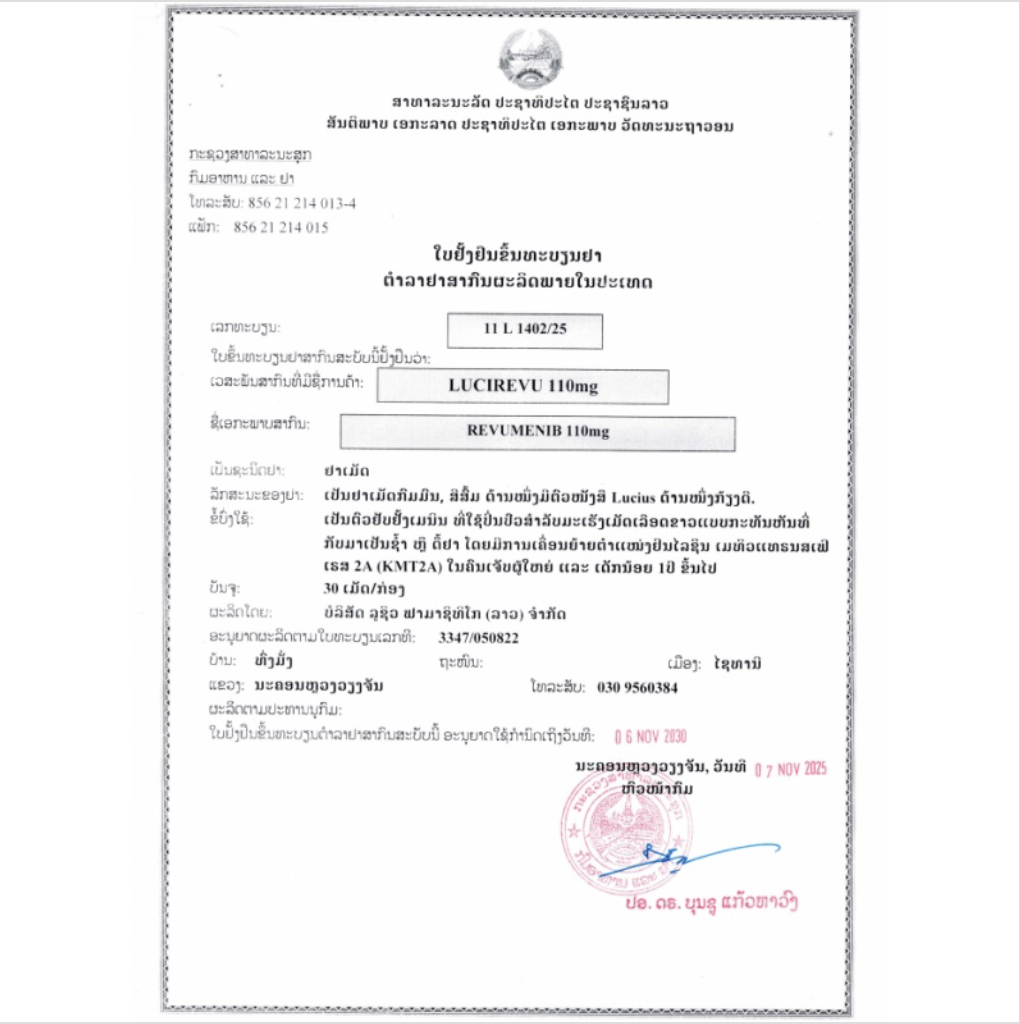
LuciRevu is a menin inhibitor indicated for the treatment of relapsed or refractory acute leukemia with a lysine methyltransferase 2A gene (KMT2A) translocation in adult and pediatric patients 1 year and older.
DOSAGE AND ADMINISTRATION
• Select patients for treatment with LuciRevu based on the presence of a KMT2A translocation.
• Administer LuciRevu orally twice daily fasted or with a low-fat meal at approximately the same time each day.
• The recommended dosage of LuciRevu varies by patient weight and concomitant use of strong CYP3A4 inhibitors. See Table 1 for the recommended dosage for patients 1 year and older. Do not start LuciRevu until the WBC is reduced to less than 25 Gi/L. Continue LuciRevu until disease progression or unacceptable toxicity. For patients without disease progression or unacceptable toxicity, treat for a minimum of 6 months to allow time for clinical response.
|
Patient Weight |
Without Strong CYP3A4 Inhibitors |
With Strong CYP3A4 Inhibitors |
|
40 kg or more |
270 mg orally twice daily |
160 mg orally twice daily |
|
Less than 40 kg |
160 mg/m2 orally twice daily |
95 mg/m2 orally twice daily |
• See Full Prescribing Information for dosage modifications, and administration instructions.
DOSAGE FORMS AND STRENGTHS
Tablets: 110mg×30 tablets/bottle
CONTRAINDICATIONS
None
WARNINGS AND PRECAUTIONS
• QTc Interval Prolongation: Monitor electrocardiograms and electrolytes. Correct hypokalemia and hypomagnesemia prior to and during treatment. If QTc interval prolongation occurs, interrupt, reduce, or permanently discontinue LuciRevu.
• Embryo-Fetal Toxicity: Can cause fetal harm. Advise females of reproductive potential and males with female partners of reproductive potential of potential risk to a fetus and to use effective contraception.
ADVERSE REACTIONS
The most common adverse reactions (≥ 20%) including laboratory abnormalities, are hemorrhage, nausea, phosphate increased, musculoskeletal pain, infection, aspartate aminotransferase increased, febrile neutropenia, alanine aminotransferase increased, parathyroid hormone intact increased, bacterial infection, diarrhea, differentiation syndrome, electrocardiogram QT prolonged, phosphate decreased, triglycerides increased, potassium decreased, decreased appetite, constipation, edema, viral infection, fatigue, and alkaline phosphatase increased.
DRUG INTERACTIONS
• Strong CYP3A4 Inhibitors: Reduce the LuciRevu dose.
• Strong or moderate CYP3A4 Inducers: Avoid concomitant use with LuciRevu.
• QTc Prolonging Drugs: Avoid concomitant use with LuciRevu. If concomitant use is unavoidable, monitor patients more frequently for QTc interval prolongation.
USE IN SPECIFIC POPULATIONS
• Lactation: Advise not to breastfeed.
Storage
Store at 20°C to 25°C (68°F to 77°F), excursions permitted between 15°C and 30°C (59°F and 86°F) [see USP Controlled Room Temperature]. Protect from moisture.