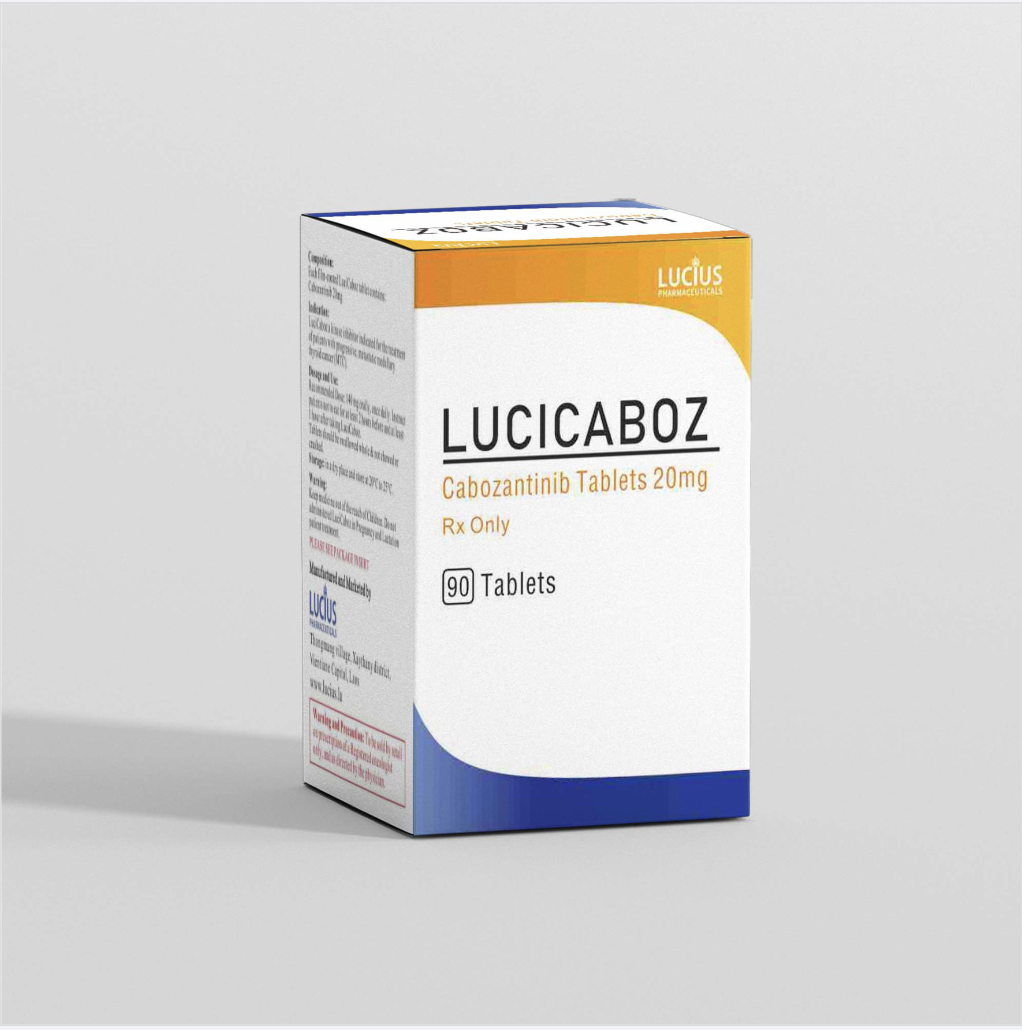
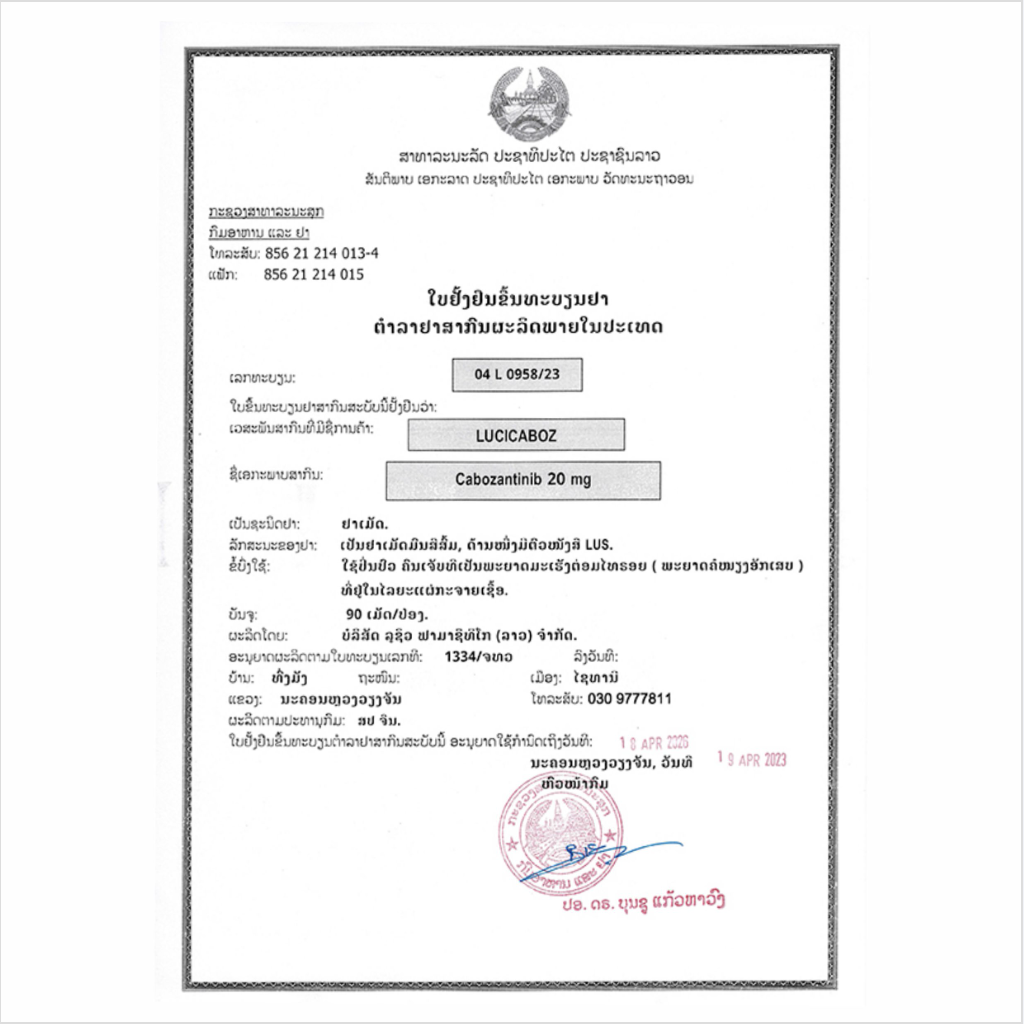

HIGHLIGHTS OF PRESCRIBING INFORMATION
These highlights do not include all the information needed to use LuciCaboz safely and effectively. See full prescribing information for LuciCaboz.
INDICATIONS AND USAGE
LuciCaboz is a kinase inhibitor indicated for the treatment of
• patients with advanced renal cell carcinoma (RCC)
• patients with advanced renal cell carcinoma, as a first-line treatment in combination with nivolumab.
• patients with hepatocellular carcinoma (HCC) who have been previously treated with sorafenib.
• adult and pediatric patients 12 years of age and older with locally advanced or metastatic differentiated thyroid cancer (DTC) that has progressed following prior VEGFR-targeted therapy and who are radioactive iodine-refractory or ineligible.
DOSAGE AND ADMINISTRATION
• Stop treatment with LuciCaboz at least 3 weeks prior to scheduled surgery, including dental surgery.
• Do NOT substitute LuciCaboz tablets with cabozantinib capsules.
• Recommended Dose:
• 60 mg orally, once daily.
• 40 mg orally, once daily, in pediatric patients with BSA less than 1.2 m2.
• 40 mg orally, once daily, administered in combination with nivolumab 240 mg every 2 weeks or 480 mg every 4 weeks.
• Administer at least 1 hour before or at least 2 hours after eating.
DOSAGE FORMS AND STRENGTHS
Tablets: 20 mg×90 tablets
CONTRAINDICATIONS
None.
WARNINGS AND PRECAUTIONS
• Hemorrhage: Do not administer LuciCaboz if recent history of hemorrhage.
• Perforations and Fistulas: Monitor for symptoms. Discontinue LuciCaboz for Grade 4 fistula or perforation.
• Thrombotic Events: Discontinue LuciCaboz for myocardial infarction or serious venous or arterial thromboembolic events.
• Hypertension and Hypertensive Crisis: Monitor blood pressure regularly. Interrupt for hypertension that is not adequately controlled with anti-hypertensive therapy. Discontinue LuciCaboz forhypertensive crisis or severe hypertension that cannot be controlled with anti-hypertensive therapy.
• Diarrhea: May be severe. Interrupt LuciCaboz until diarrhea resolves or decreases to ≤Grade 1, resume at reduced dose. Recommend standard antidiarrheal treatments.
• Palmar-Plantar Erythrodysesthesia (PPE): Interrupt LuciCaboztreatment until PPE resolves or decreases to Grade 1.
• Hepatotoxicity: When used in combination with nivolumab, higher frequencies of Grade 3 and 4 ALT and AST elevation may occur than with LuciCaboz alone. Monitor liver enzymes before initiation of and periodically throughout treatment. Consider withholding LuciCaboz and/or nivolumab, initiating corticosteroid therapy, and/or permanently discontinuing the combination for severe or lifethreatening hepatotoxicity.
• Adrenal Insufficiency: When used in combination with nivolumab, primary or secondary adrenal insufficiency may occur. For Grade 2 or higher adrenal insufficiency, initiate symptomatic treatment, including hormone replacement as clinically indicated. Withhold LuciCaboz and/or nivolumab depending on severity.
• Proteinuria: Monitor urine protein. Interrupt LuciCaboz until proteinuria resolves to ≤ Grade 1, resume LuciCaboz at a reduced dose. Discontinue for nephrotic syndrome.
• Osteonecrosis of the jaw (ONJ): Withhold LuciCaboz for at least 3 weeks prior to invasive dental procedures and for development of ONJ.
• Impaired Wound Healing: Withhold LuciCaboz for at least 3 weeks before elective surgery. Do not administer for at least 2 weeks following major surgery and adequate wound healing. The safety of resumption of LuciCaboz after resolution of wound healing complications has not
been established.
• Reversible Posterior Leukoencephalopathy Syndrome (RPLS): Discontinue LuciCaboz.
• Thyroid Dysfunction: Monitor thyroid function before and during treatment with LuciCaboz.
• Hypocalcemia: Withhold LuciCaboz and resume at reduced dose upon recovery or permanently discontinue LuciCaboz depending on severity.
• Embryo-Fetal Toxicity: Can cause fetal harm. Advise females of reproductive potential of the potential risk to a fetus and to use effective contraception.
ADVERSE REACTIONS
The most common (≥ 20%) adverse reactions are:
• as a single agent: diarrhea, fatigue, PPE, decreased appetite, hypertension, nausea, vomiting, weight decreased, constipation.
• in combination with nivolumab: diarrhea, fatigue, hepatotoxicity, PPE, stomatitis, rash, hypertension, hypothyroidism, musculoskeletal pain, decreased appetite, nausea, dysgeusia, abdominal pain, cough, and upper respiratory tract infection.
DRUG INTERACTIONS
• Strong CYP3A4 inhibitors: Reduce the LuciCaboz dosage if coadministration cannot be avoided.
• Strong CYP3A4 inducers: Increase the LuciCaboz dosage if coadministration cannot be avoided.
USE IN SPECIFIC POPULATIONS
• Hepatic Impairment: Reduce the LuciCaboz dosage for patients with moderate hepatic impairment. Avoid in patients with severe hepatic impairment.
• Lactation: Advise not to breastfeed.
• Pediatric Use: Monitor open growth plates in adolescent patients. Consider interrupting or discontinuing LuciCaboz if abnormalities occur.
Storage
Store at 20℃ to 25℃ (68℉ to 77℉), excursions permitted between 15℃ and 30℃ (59℉ and 86℉) [see USP Controlled Room Temperature]. Protect from moisture.