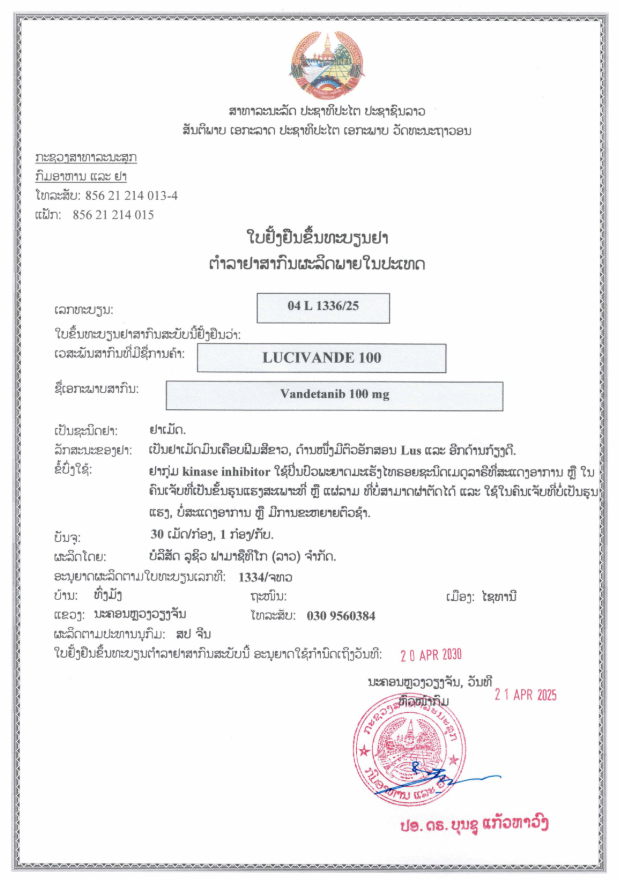
LUCIUS Vandetanib 100mg [Film-coated Tablets]
Prescribing Information Simulation
Disclaimer: This is a simulated summary based on the known pharmacological data of Vandetanib and generic drug manufacturing standards. It is intended for informational purposes only and does not replace the official prescribing information provided by Lucius Pharmaceutical or the advice of a qualified healthcare professional. Always consult a medical doctor for treatment decisions. The brand name "Caprelsa" is a registered trademark of AstraZeneca; the generic name is Vandetanib.
1. TRADE NAME
LUCIUS Vandetanib 100mg Tablets
2. COMPOSITION
Each film-coated tablet contains:
Vandetanib 100 mg
3. PHARMACEUTICAL FORM
Film-coated tablet.
4. CLINICAL PARTICULARS
4.1 Therapeutic Indications
LUCIUS Vandetanib is indicated for the treatment of symptomatic or progressive medullary thyroid cancer (MTC) in patients with unresectable locally advanced or metastatic disease.
4.2 Posology and Method of Administration
Administration must be initiated under the guidance of a physician experienced in the use of anticancer therapies.
-
Recommended Dose: The recommended dose is 300 mg once daily.
-
Administration: Vandetanib should be taken orally, with or without food.
-
Tablet Intake: Tablets should be swallowed whole with a glass of water. Do not crush the tablets.
-
Dose Adjustment: Dose interruption or reduction (to 200 mg or 100 mg) is recommended in patients who experience severe toxicities, including but not limited to:
-
Serious skin reactions
-
QTc interval prolongation
-
Interstitial lung disease (ILD)
-
Severe hypertension
-
Heart failure
-
Ischemic cerebrovascular events
-
Renal impairment
-
-
Hepatic Impairment: Not recommended in patients with moderate to severe hepatic impairment.
-
Renal Impairment: Use with caution in patients with mild to moderate renal impairment. Not recommended in patients with severe renal impairment.
4.3 Contraindications
-
Hypersensitivity to the active substance or to any of the excipients.
-
Congenital long QT syndrome.
-
Patients with severe renal impairment (creatinine clearance <30 mL/min).
-
Coadministration with drugs known to prolong the QT interval (e.g., certain antiarrhythmics) and with strong CYP3A4 inducers (e.g., rifampicin, phenytoin, St. John's Wort).
4.4 Special Warnings and Precautions
Vandetanib treatment is associated with several serious risks that require careful monitoring:
-
QT Prolongation and Torsades de Pointes: Vandetanib can significantly prolong the QT interval, which can lead to life-threatening arrhythmias (Torsades de Pointes) and sudden death.
-
Monitoring: ECGs and serum electrolytes (potassium, calcium, magnesium) must be monitored at baseline, during dose escalation, and periodically during treatment.
-
Action: Dose reduction or discontinuation is required for QTc >500 ms.
-
-
Serious Skin Reactions: Stevens-Johnson Syndrome (SJS) and toxic epidermal necrolysis (TEN), which can be fatal, have been reported.
-
Action: Permanently discontinue vandetanib for severe skin reactions.
-
-
Interstitial Lung Disease (ILD/Pneumonitis): Fatal events have occurred. Monitor for pulmonary symptoms (e.g., dyspnea, cough, fever). Discontinue therapy for confirmed ILD.
-
Ischemic Cerebrovascular Events: Increased risk of strokes and transient ischemic attacks (TIAs).
-
Heart Failure: Monitor for signs and symptoms of cardiac dysfunction.
-
Hypertension: Monitor blood pressure regularly. Control hypertension with appropriate medication; may require dose interruption or reduction of vandetanib.
-
Hemorrhage: Serious hemorrhagic events, including fatal events, can occur.
-
Diarrhea: Can be severe. Standard antidiarrheal agents should be used; dose interruption or reduction may be necessary.
-
Hypothyroidism: Monitor thyroid function during treatment as vandetanib may require increased doses of thyroid hormone replacement therapy.
-
Reversible Posterior Leukoencephalopathy Syndrome (RPLS): A rare but serious condition. Discontinue therapy if diagnosed.
4.5 Interaction with other Medicinal Products
-
QT-Prolonging Drugs: Coadministration is contraindicated due to additive risk of torsades de pointes (e.g., antiarrhythmics like amiodarone, disopyramide; certain antibiotics like moxifloxacin).
-
Strong CYP3A4 Inducers: Coadministration is contraindicated (e.g., rifampicin, carbamazepine, phenobarbital, St. John's Wort) as they may decrease vandetanib plasma concentrations.
-
Drugs that may cause electrolyte imbalance (e.g., diuretics) should be used with caution.
4.6 Pregnancy and Lactation
-
Pregnancy: Vandetanib can cause fetal harm when administered to a pregnant woman. It is embryotoxic and fetotoxic in animal models. Effective contraception is required during and for at least 4 months after treatment.
-
Lactation: It is unknown whether vandetanib is excreted in human milk. A decision should be made to discontinue breastfeeding or discontinue the drug, taking into account the importance of the drug to the mother.
4.7 Effects on Ability to Drive and Use Machines
Patients should be advised that they may experience side effects such as fatigue, dizziness, or blurred vision, which could affect their ability to drive or operate machinery.
4.8 Undesirable Effects (Adverse Reactions)
Summary of selected very common and common adverse reactions:
-
Very Common (≥1/10):
-
Diarrhea, nausea, vomiting, abdominal pain
-
Rash (including acneiform dermatitis), dry skin, pruritus, photosensitivity
-
Hypertension
-
Headache, fatigue
-
Decreased appetite
-
Prolonged QT interval (on ECG)
-
Corneal opacity (asymptomatic)
-
-
Common (≥1/100 to <1/10):
-
Severe skin reactions (e.g., SJS), urticaria
-
Interstitial lung disease
-
Heart failure, ischemic cerebrovascular events
-
Hemorrhage
-
Renal impairment
-
Blurred vision
-
5. PHARMACOLOGICAL PROPERTIES
5.1 Pharmacodynamic Properties
-
Pharmacotherapeutic group: Protein kinase inhibitor, antineoplastic agent.
-
Mechanism of Action: Vandetanib is a potent tyrosine kinase inhibitor (TKI) that targets key receptors involved in thyroid cancer pathogenesis:
-
RET (Rearranged during Transfection) proto-oncogene: A primary target in hereditary and sporadic MTC.
-
VEGFR (Vascular Endothelial Growth Factor Receptor): Inhibits angiogenesis (blood vessel formation that feeds tumors).
-
EGFR (Epidermal Growth Factor Receptor): Inhibits tumor cell proliferation and survival.
-
6. PHARMACEUTICAL PARTICULARS
6.1 Shelf Life
-
As stated on the packaging (typically 24-36 months).
6.2 Special Precautions for Storage
-
Store below 30°C.
-
Keep the blister strips in the outer carton to protect from light and moisture.
6.3 Name and Address of the Marketing Authorization Holder
Lucius Pharmaceutical Co., Ltd.
Address: [Address would be listed here, e.g., Saphanthong Neua Village, Sisattanak District, Vientiane Capital, Lao P.D.R.]
Important Note for Patients:
This medication must be dispensed through a restricted distribution program due to its serious risks. Patients will likely be required to enroll in a patient safety program to ensure they understand the risks and necessary monitoring, particularly for QT prolongation.
whatsapp:+852 61905607
wechat:yindu7689